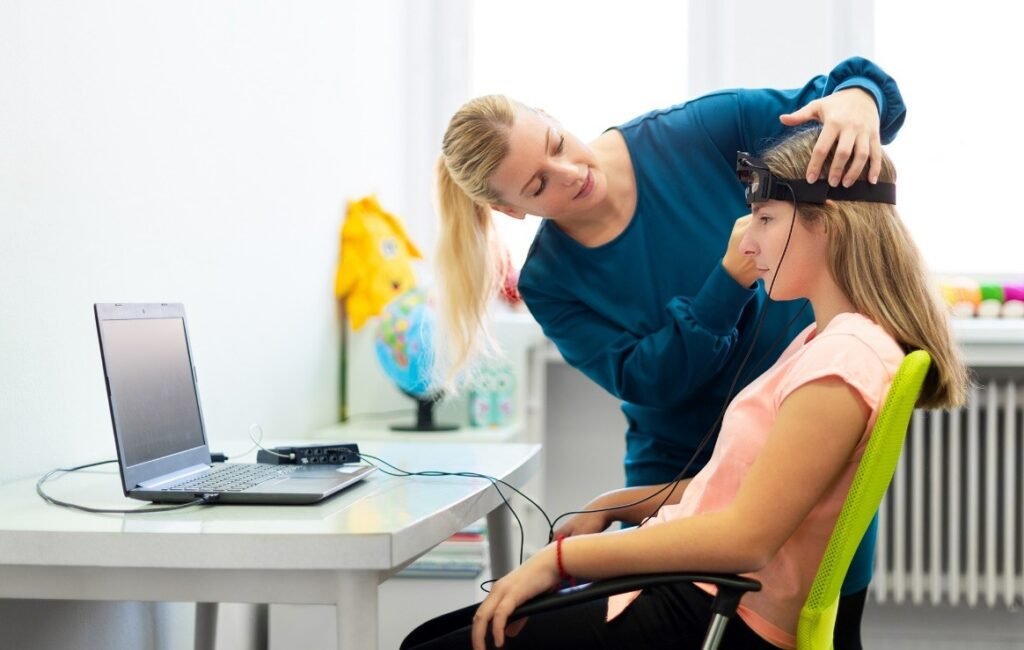

As life expectancy increases, so does interest in maintaining mental sharpness well into older adulthood. Cognitive performance and longevity — preserving memory, focus, and processing speed — has become a major public health goal. Among emerging non-pharmacological tools, neurofeedback is gaining attention for its potential role in supporting brain health.
This article explores the science, mechanisms, and research behind neurofeedback for healthy cognitive aging — with peer-reviewed references included at the end.
Key Takeaways
-
- The aging brain retains neuroplasticity.
- Neurofeedback trains self-regulation of brain activity.
- Early studies using targeted neurofeedback therapy show improvements in memory, attention, and sleep.
- Neurofeedback may serve as a complementary tool for addressing mild cognitive impairment.
- More large-scale trials are needed to confirm long-term efficacy.
- Neurofeedback works best alongside exercise, nutrition, quality sleep, and cognitive engagement.
What Is Neurofeedback?
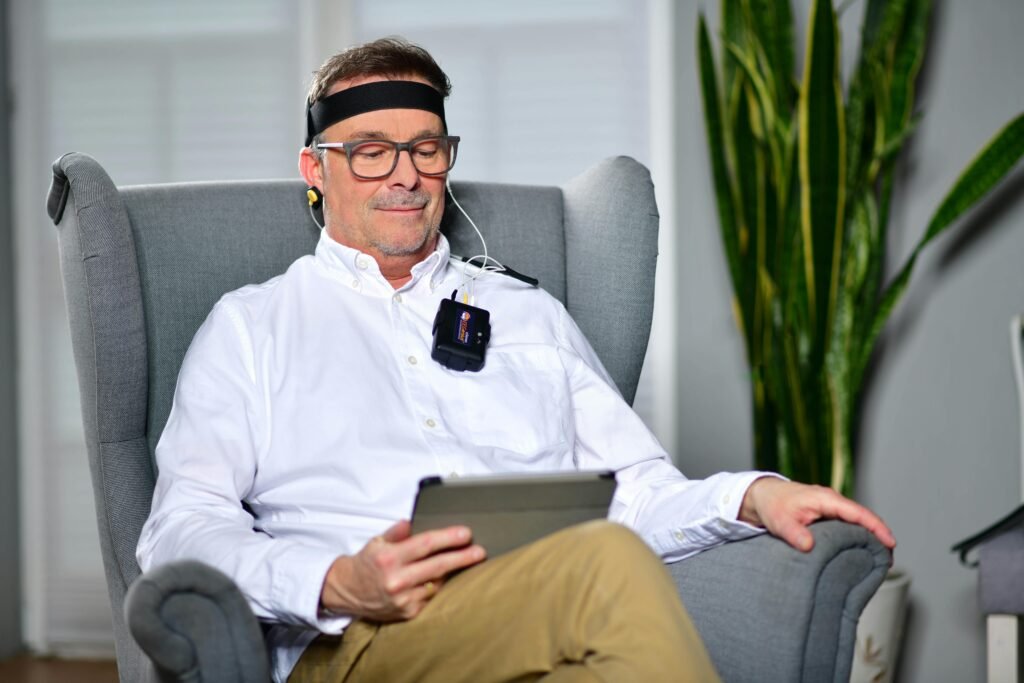
Neurofeedback (EEG biofeedback) is a non-invasive method that trains individuals to regulate their own brainwave activity. Using scalp sensors, clinicians measure electrical activity in the brain (electroencephalography, or EEG). Using real-time feedback — often visual or auditory — allows the brain to gradually learn more efficient activity patterns through operant conditioning. Rather than stimulating the brain externally, neurofeedback works by enhancing self-regulation, leveraging the brain’s natural plasticity. For more information about Neurofeedback click here https://mbcllchealth.com/what-is-neurofeedback/
How the Brain Changes With Age
The Neuroscience: Why Neurofeedback May Help
Normal aging is associated with predictable neurophysiological changes:
-
- Slower processing speed
- Reduced working memory capacity
- Decreased cognitive flexibility
- Increased distractibility
- Altered sleep patterns
EEG research shows aging often involves:
-
- Increased slow-wave activity (theta, delta)
- Reduced beta activity (associated with focus and executive function)
- Reduced connectivity between cortical regions
In the aging brain, these changes may progress to mild cognitive impairment (MCI) and neurodegenerative disorders such as Alzheimer’s disease.
However, aging does not eliminate neuroplasticity. The brain retains the ability to reorganize and adapt — even in later decades of life.
Neurofeedback is based on three key principles:
-
- Neuroplasticity persists across the lifespan
- Brainwave patterns reflect cognitive and emotional states
- Self-regulation can be learned through feedback
Recent research from teams at UCLA and Harvard Medical School has demonstrated that targeted cognitive and neural training can produce measurable functional changes in older adults.
Neurofeedback protocols for aging populations typically aim to:
-
- Decrease excessive theta activity (mental fog, inattention)
- Increase beta or sensorimotor rhythm (SMR) activity (alertness, stability)
- Improve inter-regional coherence (network efficiency)
What the Research Says
While the field is still developing, a growing body of peer-reviewed research suggests neurofeedback may support cognitive performance in older adults.

1. Improvements in Memory and Executive Function
1. Improvements in Memory and Executive Function
Several small randomized and controlled trials have demonstrated improvements in:
-
- Working memory
- Verbal recall
- Sustained attention
- Executive control
For example, studies using SMR and beta enhancement protocols have reported measurable gains in memory performance among adults over 60.
2. Mild Cognitive Impairment (MCI)
Neurofeedback has been explored as a complementary intervention for individuals with mild cognitive impairment, a condition that can precede Alzheimer’s disease.
Preliminary findings suggest:
-
- Increased functional connectivity
- Improved delayed recall
- Reduced cognitive variability
Though promising, these studies remain small and require replication.


3. Sleep Enhancement
Sleep plays a critical role in glymphatic clearance, memory consolidation, and emotional regulation. Aging often disrupts slow-wave and REM sleep.
SMR-based neurofeedback protocols have been associated with:
-
- Faster sleep onset
- Increased sleep spindle activity
- Improved subjective sleep quality
Better sleep may indirectly support cognitive resilience.
4. Mood and Emotional Regulation
Late-life anxiety and depression are associated with accelerated cognitive decline. Neurofeedback has shown benefit in reducing anxiety and improving emotional stability, which may secondarily support cognitive performance.

Safety and Practical Considerations
Neurofeedback is:
-
- Non-invasive
- Drug-free
- Well tolerated
Side effects are uncommon and typically mild (temporary fatigue or headache). Training should be administered by qualified professionals experienced in EEG-based interventions.
Limitations of Current Evidence
Despite encouraging findings, several limitations remain:
-
- Small sample sizes
- Variability in protocols
- Limited long-term follow-up
- Need for larger randomized controlled trials
Systematic reviews conclude that neurofeedback shows promise but requires more rigorous, standardized research before becoming a mainstream cognitive aging intervention.

Research Articles and Scientific References
Below are peer-reviewed articles and reviews relevant to neurofeedback and aging:
-
- Escolano, C., Navarro-Gil, M., Garcia-Campayo, J., et al. (2014). EEG-based upper alpha neurofeedback improves working memory performance in healthy elderly participants. Clinical Neurophysiology, 125(3), 532–541.
- Wang, J.-R., Hsieh, S. (2013). Neurofeedback training improves attention and working memory performance in older adults. Frontiers in Aging Neuroscience, 5, 1–10.
- Lecomte, G., Juhel, J. (2011). The effects of neurofeedback training on memory performance in elderly subjects. Psychology, 2(8), 846–852.
- Gruzelier, J. H. (2014). EEG-neurofeedback for optimising performance. I: A review of cognitive and affective outcome in healthy participants. Neuroscience & Biobehavioral Reviews, 44, 124–141.
- Marzbani, H., Marateb, H. R., Mansourian, M. (2016). Methodological note: Neurofeedback: A comprehensive review on system design, methodology and clinical applications. Basic and Clinical Neuroscience, 7(2), 143–158.
- Lavy, Y., Dwolatzky, T., Kaplan, Z., et al. (2019). Neurofeedback improves memory and peak alpha frequency in individuals with mild cognitive impairment. Journal of Alzheimer’s Disease, 67(3), 1–12.
- Enriquez-Geppert, S., Huster, R. J., Herrmann, C. S. (2017). EEG-neurofeedback as a tool to modulate cognition and behavior: A review tutorial. Frontiers in Human Neuroscience, 11, 51.
Residents of DC, MD, VA and PA can learn more or schedule a consultation with Mind Body Connections at https://www.mbcllchealth.com.