
Understanding your mind through a calmer, more compassionate lens can transform the way you experience anxiety and stress.
Rather than viewing your reactions as problems to fix, this approach invites you to see them as signals from a nervous system that may be overwhelmed or dysregulated. By learning how to regulate your mood and body naturally—through techniques like guided imagery, mindful breathing, neurofeedback and self-awareness—you can reduce anxiety, improve emotional regulation, and build lasting resilience. This holistic perspective not only supports mental health but also empowers you to respond to life’s challenges with greater clarity, confidence, and calm.
Key Takaways
-
- Many symptoms like anxiety, ADHD, and overwhelm are rooted in nervous system dysregulation, not “brokenness”
- Your brain is adaptive, not defective—it’s responding to stress, past experiences, and environment
- You can retrain and regulate your brain through approaches like neurofeedback and guided imagery
- Lasting change happens when the brain and body feel safe enough to shift
You Were Never Broken
There’s a quiet belief many people carry:
“Something is wrong with me.”
Maybe it shows up when your mind won’t slow down at night.
Or when you react more strongly than you wish you did.
Or when focus feels just out of reach, no matter how hard you try.
Over time, those moments can begin to feel like evidence.
Like proof.
But what if they aren’t?
What if your brain isn’t broken at all…
but simply trying—very hard—to protect you?

What Nervous System Dysregulation Really Means
Your brain and nervous system are designed for one primary purpose: to keep you safe.
When everything is balanced, you can move fluidly between states:
- Calm and focused
- Alert and engaged
- Restful and restored
But when stress becomes chronic—whether from life experiences, emotional strain, or even subtle, ongoing pressure—the system adapts.
It learns new patterns:
- Staying “on” too long (anxiety, overthinking, restlessness)
- Shutting down too quickly (fatigue, disconnection, low motivation)
- Struggling to shift between states
This is what we call dysregulation. Not damage. Not failure.
Just a system that has learned to operate in survival mode.
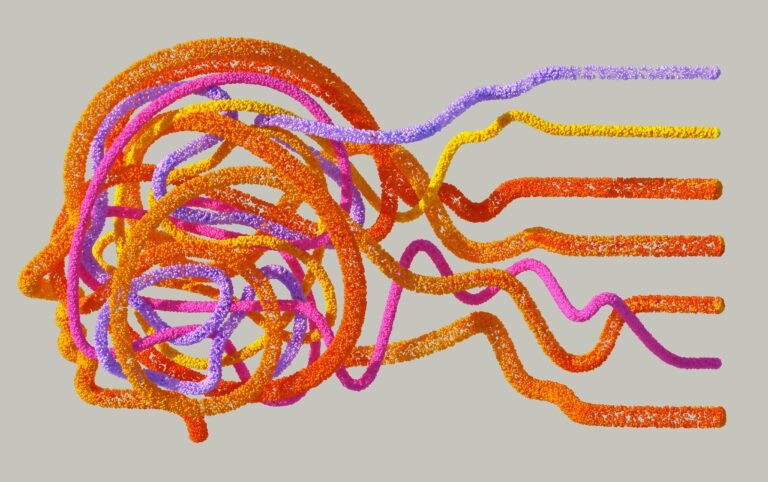
The Overthinking Brain, the Anxious Body
If you’ve ever been told to “just relax” or “stop overthinking,” you already know—it’s not that simple.
Because dysregulation isn’t a mindset problem.
It’s a brain-body pattern.
Your brain may be:
- Moving too fast
- Getting stuck in loops
- Scanning for threat, even when you’re safe
- And your body follows:
- Tight chest
- Restless energy
- Trouble sleeping
- Emotional reactivity
- These aren’t signs of weakness.
They’re signs your system has learned to stay prepared.
A Different Way to Understand Yourself
Instead of asking:
“What’s wrong with me?”
Try gently shifting the question to:
“What has my brain learned… and why?”
This small shift creates space.
And in that space, something powerful begins to happen:
Compassion replaces judgment.
Curiosity replaces frustration.
And change becomes possible.
A Moment to Experience It Differently
If you’re open to it, take a slow breath here. And imagine this:

You’re standing at the edge of a quiet forest.
The air is still.
The ground beneath you steady.
In the distance, you notice a small clearing…
and in that clearing, a softly glowing light.
This light represents your nervous system—your mind,
your body, your internal world.
At times, maybe that light has felt:
- too bright, flickering quickly
- or dim, hard to access
- or constantly shifting
But as you stand here, just observing…
you begin to notice something else.
The light isn’t broken.
It’s responding to wind and weather; to everything it has experienced.
And as the forest around it grows calmer…the light begins to steady.
Not because you forced it to, but because the environment allowed it.
Take another slow breath.
And let that idea settle:
Your brain changes when it feels safe enough to.
How Regulation Actually Happens
True change doesn’t come from pushing harder.
It comes from helping your brain learn a new pattern.
This is where the following approaches can be incredibly powerful:
Neurofeedback (training brainwave patterns)
Guided imagery (engaging the brain through visualization)
Nervous system regulation techniques
These approaches work not by forcing change, but instead they teach your system how to shift out of dysregulation.
Over time, your brain begins to:
- Spend less time in survival states
- Transition more easily between emotions
- Feel calmer, clearer, more focused

You Are Not Stuck
If your brain has learned patterns, it can unlearn and relearn them.
That means:
- Anxiety can soften
- Focus can improve
- Emotional responses can feel more manageable…. Not overnight.
But gradually, gently, and sustainably.
A Final Thought
The next time you catch yourself thinking:
“Why am I like this?”
See if you can pause… just for a moment.
And remember:
Your brain adapted to help you survive.
Now, it may simply need support to help you live.
Ready to Take the Next Step?
If this resonates with you, you’re not alone—and you don’t have to figure it out by yourself.
At Mind Body Connections, we focus on helping your brain and nervous system move out of survival mode and into balance through personalized, brain-based approaches.
Whether you’re struggling with anxiety, ADHD, or feeling stuck, regulation is possible.
And it starts with understanding:
You were never broken.
Residents of DC, MD, VA and PA can learn more or schedule a consultation with Mind Body Connections at https://www.mbcllchealth.com.